Showing posts with label rural development. Show all posts

Friday, 19 May 2017

A love of Lemurs leads to making a real difference in Madagascar

Back in February, Patricia Wright – a renowned primatologist and Anthropologist at Stony Brook University – visited Luther College, Iowa (both USA). This may seem quite ordinary between American academics, what makes this visit special then? – the subject. In her lecture and following events, Wright told of her personal love for Lemurs, her academic work in Biology and also how she had helped found Madagascar’s Ranomafana National Park.

 
Professor Wright is acclaimed for conservation and biology in Madagascar, specialising in the social nature of Lemurs. In this lecture she highlighted how females play a central role in groups, also she explored the history of Lemurs in Madagascar and how they manage today – and of course, how we can help them survive.

The positives of this talk? Students claimed they had a greater sense of personal growth and were more aware of how sometimes seemingly small acts can make a big difference to countries like Madagascar.

Students heard of not only the immense work which Professor Wright has done, but also about the importance of getting a balance between supporting both the rainforests that the Lemurs inhabit, alongside solving social problems. Wright made it clear that to help maintain the unique natural environment, the local people must be taken into account and supported too.  


This is also the approach of MFM – supporting the local people - enabling them to survive, thrive and appreciate the unique landscape and species. MFM is proud to help provide some of the things which Wright stressed the importance of – such as health care, education, information and financial support to start alternative livelihoods. 

If you would like to know more about the work of MFM, or if you could make a donation which would help make a direct impact on both the lives of the Malagasy people and the Lemurs that they live alongside, please visit:
https://www.moneyformadagascar.org


Sources –

(Both accessed 11/04/2017)


5/04/2017


28/03/2017

- Written by Matthew Ward -

Friday, 11 November 2016

URGENT APPEAL: Madagascar Drought Relief


The United Nations has warned that 1.5 million Malagasy people face severe hunger and food shortages because of the ongoing drought in the south of the country (link). The ‘El Nino’ phenomenon has resulted in unusually dry weather and means that harvests are substantially below their usual levels, with families in affected areas resorting to eating seed stocks which will further exacerbate the situation over the coming months. 


According to the UN, over a million people living in the affected regions have low food security. Without urgent action to secure food sources for these people the situation could become substantially worse. We need urgent help to allow our partners to buy new drought-resistant seed stock and equipment for farmers.  Money for Madagascar is running an urgent appeal to help those affected by this drought. Please donate now if you can!

To donate, click here.

To find out more about the crisis currently unfolding, visit http://www.fao.org/news/story/en/item/449030/icode/.

Thursday, 12 May 2016

Irenee to be awarded the Chevalier de l’Ordre National Malagasy!


We are happy to share some exciting news with you all. Tomorrow, Friday 13th of May, the director of MfM – Irenee Rajaona-Horne - will be awarded the ‘Chevalier de l’Ordre National’ (a knighthood) from the Government of Madagascar in recognition of her services to the children of Madagascar.

The ceremony will take place in Madagascar at one of 34 schools taking part in MfM's Education for life programme. It will involve a guard of honour and will be attended by all the local dignitaries. We will be publishing more details on the event in the next fortnight.

For the past 20 years Irenee has worked tirelessly to help improve the lives of vulnerable and destitute children in Madagascar.

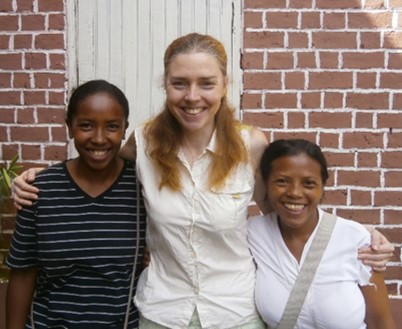
During her 10 years as a Quaker Volunteer at Akany Avoko Children’s Centre (1998-2008), Irenee worked directly with destitute children as well as helping to raise vital funds to enable the centre to continue its work. The attached photo shows Irenee with two women whom Irenee taught many years ago as teenagers. "It is a delight to see the children, who were once destitute,  grow up into caring parents who are able to provide a home and an education for their children." (said Irenee)

Since her return to Lancaster in 2008, Irenee has worked for Money for Madagascar, initially as the Development Officer and now as the Director. In this time MfM has had the privilege to support over 10,000 Malagasy people to fight against poverty and improve the environment.

Irenee would like to thank all the Malagasy partners who have made this work possible.  Likewise we would not have been able to make such a positive difference without the help of supporters like you. So thank you for your encouragement, interest and contributions!

To find out more about what we do in Madagascar and to see how you can get involved visit https://www.moneyformadagascar.org. To make a donation to support our partners who are trying to protect forests and livelihoods in Madagascar, please visit
http://moneyformadagascar.org/english/make-a-donation.asp


Thursday, 24 March 2016

Job Vacancy - MfM Seeks Madagascar Country Representative

Money for Madagascar seeks a country representative to be based in Antananarivo starting in July 2016. Applications are invited from individuals as well as from NGOs who are interested to deliver the services that Money for Madagascar requires.

Money for Madagascar is a British charity founded in 1986 to enable Malagasy people to reduce poverty and protect the environment through sustainable, community-led initiatives.  Beneficiaries include: orphans, street children, and vulnerable teenaged girls, farmers in environmental hotspots and women’s cooperatives, in Central, Eastern and Western Madagascar. MfM seeks an experienced development agent with the dynamism and commitment needed to enable MfM to scale-up its work.
  1. As the Money for Madagascar Country Representative you will support and strengthen a network of Malagasy NGOs to help Malagasy people to climb out of poverty and restore Madagascar’s unique eco-system. You will do this by providing the following services:
  2.  Representing MfM nationally for example on development and environmental forums, in order to create opportunities for new collaborations and to help MfM to respond to current needs and opportunities in Madagascar.
  3. Helping Money for Madagascar to demonstrate the impact of its work by supporting its partner NGOs with Reporting, Monitoring & Evaluation. This will include providing Capacity-Building Training tailored to the needs of the NGOs.
  4. Helping Money for Madagascar to develop its programmes by supporting partners, networking and identifying new funding streams.
  5. Facilitating communication between Money for Madagascar’s UK Office and its Malagasy NGO partners. 

This new role will start on a consultancy basis for an initial period of 12 months. Fees will be paid upon delivery of agreed outcomes. It is envisaged that this work will be extended and developed into a permanent role with Money for Madagascar. Remuneration package for 12 month contract 7,000 GBP to 9,000 GBP.

To find out more and to make an application please follow the link to our website below:

Applications to be submitted in English or French by 10th of April 2016. Interviews in Tana 17th & 18th May 2016.

Monday, 5 November 2012

Back to school - with your help!

Access to education is a right denied to thousands of Malagasy children, none more so than those living in remote rural areas. 
Local dignitaries cut the ribbon to open the latest MfM-funded school in rural Madagascar
August saw the inauguration of the a new MFM-funded school in the rural Commune of Maritampona. This star-studded (by rural Malagasy standards!) event was attended by one of Money for Madagascar's most trusted development partners - Mr Martin Ravelomanantsoa (Director of Association ALF), who had overseen the construction project, along with a host of dignitaries including the Head of the Region. But of course the most important VIP's in attendance were the 275 excited schoolchildren whose lives will be changed by the new facility. 

The real VIP's of the inauguration - the dozens of schoolchildren whose lives will be changed by this new facility.
In his speech the Head of Region praised the new 3-classroom facility that Money for Madagascar and ALF had delivered stating that "this  new building is going to help a lot, not just the children of our village but also the children of many neighbouring villages".

The primary school at  Ampihoaramaso is the latest in a long line of schools and classrooms built by our Malagasy partner organisations thanks solely to the kindness and generosity of Money for Madagascar's supporters. Without a decent education there is little hope that the children of rural Madagascar will ever escape the poverty trap and realise their full potential. 
Director of ALF and trusted MfM partner: Martin Ravelomanantsoa accepts the congratulations of the Head of Region. 
By working through local partner organisations Money for Madagascar also helps to ensure that the capacity to identify and prioritise needs, apply for funding and manage projects through to completion is encouraged and supported.  We believe that this approach will also help ensure that the ingenuity and energy of the inspirational people we work with helps the broadest number of beneficiaries possible.

Friday, 20 January 2012

Silk moth rediscovered by SEPALI


The rediscovery of the Ceranchia silk moth brings a flutter of excitement to fledgling farmers in the North East of Madagascar


In 2011 MfM was delighted to team up with a Malagasy conservation and development NGO called SEPALI. Tapping into Madagascar’s rich heritage of silk weaving, SEPALI has launched a project to conserve forests and relieve rural poverty in the North East of Madagascar through the production of wild silk.

Madagascar suffers from acute poverty, environmental decimation with desperate suffering as a consequence. This project enables farmers to earn a living in an environmentally beneficial way. Silk cultivation is a win-win development project for both people and their environment, because in order to produce silk you need to plant trees and look after your local environment so that silk moths will thrive. By helping farmers living on the edge of a ‘Protected Area’ this project helps to preserve endangered species in 2 ways: Primarily, the cultivation of wild silk requires farmers to improve and protect their land and value the eco-system around them. Secondarily, farmers are less likely to need to encroach on the Protected Area if they have an alternative source of income.

So far 69 men and 57 women from 6 poor farming communities on the edge of the Makira Protected Area have each been given 250 indigenous trees to plant. Already 15,000 trees have been planted. In 2 years time these trees will become the host plants for the farmers’ silk worms. In between these trees farmers are planting vegetable crops to reduce predators on the silk moth larvae as well as providing much needed food for themselves. The results of this project will be: silk to sell, food to eat and a well cared-for local eco-system.

Of course the farmers aren’t just sitting around waiting for their trees to grow! As well as planting and tending their trees and crops, the farmers are making the equipment they will need for silk production, meeting to exchange ideas and train new farmers and even rediscovering a forgotten species of silk moth! The rediscovery of the Ceranchia silk moth by SEPALI in 2011 opens up potential for producing new silk products.


Meanwhile, in the US, project pioneer Dr Craig is exploring markets for SEPALI’s exotic new silk products including garments, furnishing and jewellery made from pressed silk cocoons.

With this dress made from pressed silk cocoons making it on to a New York catwalk this year, the SEPALI team is excited by potential new interest in their products.


We look forward to sharing more news from Makira as we follow the story of the farmers who are trying to improve their environment and their livelihoods with the help of indigenous silk moths.