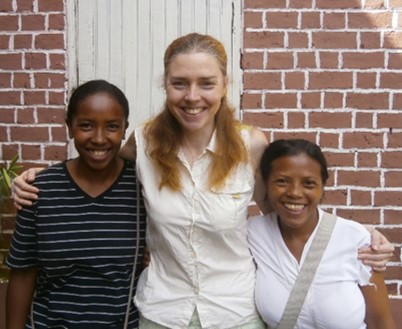
It is with sadness that we share with you the death of our dear friend and
supporter Dr Alison Jolly. Alison was a renowned world expert on lemurs, who
cared passionately about conservation and development in Madagascar. We were honoured
to count Alison amongst our dedicated supporters. In recognition of our work
she recently said:
“I applaud Money for
Madagascar’s local level, long term, investment and involvement. This is the
only real way to help local people conserve their own environment”
We thank Alison for her important contribution to science,
for her support to our charity, and for her friendship. By supporting forest communities in Betampona and Melaky MfM helps to protect the forests upon which Madagascar's lemurs depend. Although our friend is now departed, it will be our pleasure to continue this community conservation which Alison valued so highly.
The tribute
below will take you on a journey through Alison’s
career as an eminent primatologist.
In Memorium Dr
Alison Jolly
A chance invitation to babysit laboratory lemurs at Yale
University in 1959, where she was a graduate student immersed in the study of
sea sponges, triggered a change of direction and a distinguished career as a
primatologist for Alison Jolly, who has died at home in Lewes, East Sussex,
aged 76.
Driven
by a commitment to the wildlife, ecology and development of one of the world’s
poorest yet most iconic countries, Madagascar, Jolly became an expert on
lemurs. David Attenborough recently wrote: ‘not only they but the people and
land of Madagascar captured her heart’.
She
made her name as the first scientist to do an in-depth account of the behaviour
of the ring-tailed lemur, L. catta, beginning field work in 1962.
She discovered that this species ‑ and as it turned out most other lemurs ‑
have female dominance over males, breaking the then orthodoxy that primates were
male-dominant. As she later observed, the ‘king’ of the DreamWorks animation Madagascar
ought to have been a ‘queen’.
Jolly
also pioneered the argument that the evolution of intelligence has more to do
with social behaviour than ecological factors. When she published her
breakthrough Science paper in 1966, many thought intelligence evolved to
master simple tools. Jolly speculated that more likely it evolved through the
challenge of maintaining complex social relationships, a position now taken for
granted.
Working
primarily in the south of Madagascar at Berenty, a private reserve of forest
set in a semi-arid desert, her forty-year research of ring-tailed lemurs
expressed a love and scientific fascination for another species and its
environment. Lords & Lemurs: Mad Scientists, Kings With Spears, and
the Survival of Diversity in Madagascar (2004) is a compelling account of
her work and connections with the local Tandroy population and the aristocratic
semi-feudal French landowners, the De Heaulmes.
Jolly’s
perceptions were articulated with precision and clarity, notably in her classic
textbook The Evolution of Primate Behavior (1972), and later in a
consideration of the evolution of co-operation and inter-dependence, Lucy’s
Legacy: Sex and Intelligence in Human Evolution (2001). These and other
works reflected her position as a woman challenging the individualist bent of
masculinized sociobiology, though her passions were directed towards
conservation and ecology rather than feminism. Her achievements were remarkable
for a mother of four who never had a full time faculty position.
Her
approach to lemur life was holistic, arguing for approaches which worked with
local people and government, and in particular nurturing a generation of
Malagasy scientists, sometimes at her own expense. In many ways this reflected
the influence of her beloved husband of fifty years, Sir Richard Jolly, the
development economist.
Her
pragmatism together with her concerns about Madagascar’s parlous political and
economic state could sometimes sustain uncomfortable involvements, such as with
Rio Tinto in the development of the QMM titanium mine on the country’s southern
coast. She was an advisor on the independent Biodiversity Committee set up to
oversee the company’s commitment to net positive improvement in both
environment and society during the life of the mine and its pledge not to cause
the extinction of a species. As she said: “If you think that people and forest
will somehow muddle through before the hills are scraped as bare as Haiti, then
there is no reason to think that money and organization will improve life. If
you look at the statistics of forest loss, you opt for the mine.”
Enjoying
an idyllic childhood in Ithaca, New York, she was the child of the artist
Alison Mason Kingsbury and the humorist and Cornell scholar, Morris Bishop. She
quipped that since her mother knew everything about art and her father about
literature, her only choice was to become a scientist. However she was herself
a marvelous story teller about animal behavior, and vivacity peppers her
writing, with sifakas ‘silently soaring against the blue sky in great ballet
leaps’, stopping ‘to feed with no fuss or bickering’. This approach drove The
Ako Series (2005/12), a ground-breaking project to protect Madagascar’s
biodiversity jewels through books aimed at the country’s children, which she
wrote with her Malagasy colleague, Hanta Rasaminanana.
She
stood out as a tall American-in-England in her trademark Tilly bush hat,
colourful necklaces and man-sized sneakers. Her gentle professional style and
dislike of competition could veil her impressive achievements. She held a BA
from Cornell, and a PhD from Yale. She had been a researcher at the New York
Zoological Society, and the universities of Cambridge, Sussex, Rockefeller and
Princeton. At the time of her death she was a Visiting Scientist at the
University of Sussex. She was President of the International Primatological
Society 1992/96 and received its Lifetime Achievement Award in 2010. She was
awarded a Knighthood by the National Order of Madagascar in 1998 and the Osman
Hill Medal by the Primate Society of Great Britain in 2008. She received
Honorary Doctorates from the University of Antananarivo and the Università
degli Studi di Torino both in 2012. In June 2006, a new species of
mouse lemur,
Microcebus jollyae,
was named in her honour, while a parcel of recently restored mining forest in
Madagascar was named for her in January 2014, reflecting the hope that in so
doing the people involved will be more likely to sustain it.
Her books include Lemur Behavior: A Madagascar Field Study
(1966); Lucy’s Legacy: Sex and Intelligence in Human Evolution; and A World
Like Our Own: Man and Nature in Madagascar (1980). Her final book, Saving
Madagascar: Conservation Diaries of Alison Jolly will be published
posthumously. Jolly wrote over 100 scientific and popular articles and was
featured in 20 television programmes. Her writing for children included the
Fiddle stories, featuring the time-travelling adventures of a young girl,
modelled on a beloved granddaughter.
Alison Jolly is survived by her spouse, Sir Richard Jolly,
four children, Margaretta, Susan, Arthur and Richard, and four grandchildren.
Nick Fairclough, Margaretta Jolly and Arthur Jolly.